
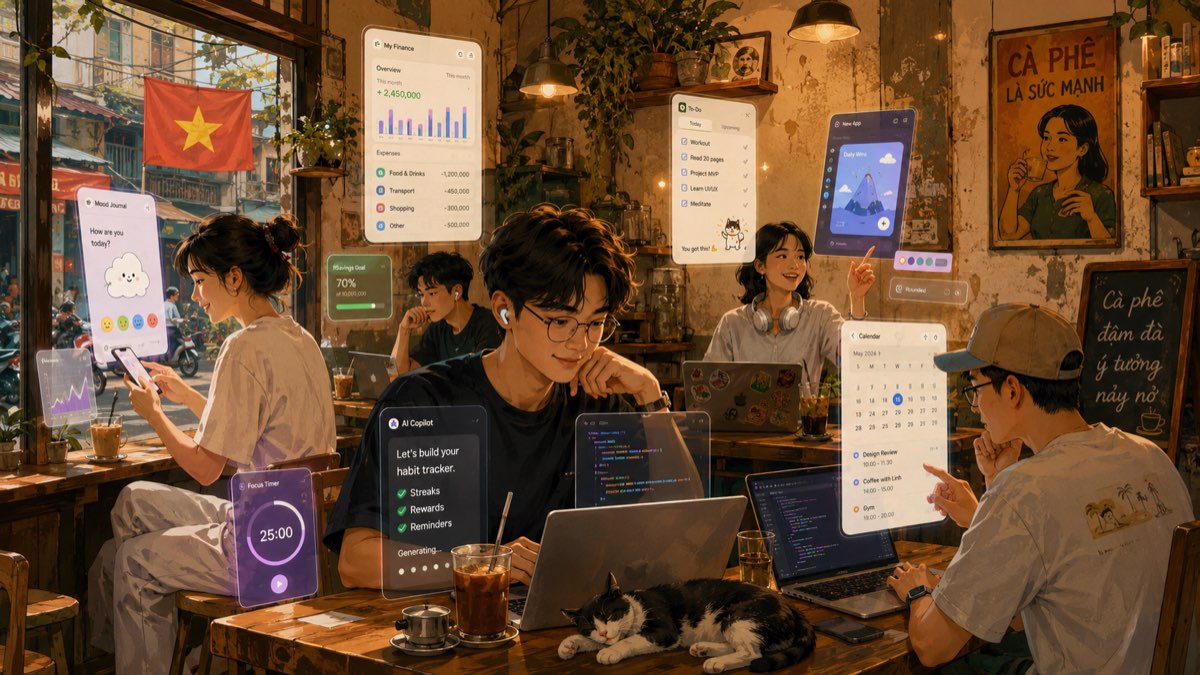
Generative AI content is popping up everywhere on the internet and social media, across text, music and video. This shift is normal as content creation becomes faster and more efficient with AI assistance. Having a highly capable AI co-working colleague changes the entire workflow, from brainstorming ideas and establishing direction to writing copy and generating images, audio and video. The cost of communication and coordination throughout this process used to be massive, often taking days, weeks or even months for each step. Generative AI makes the entire journey much more efficient.
Alongside speed and efficiency, technology enables content creation for more people, allowing them to raise their voices on the internet. Tasks that once required large teams or specialized skills no longer have barriers. Anyone can produce content or vibe code websites and applications at lightning speed. In Vietnam, generative AI communities are popping up everywhere, with users joking that you can find five vibe-coders in a single square meter. Standard calendar, finance tracking and to-do list apps are suddenly pushed aside. While these existing apps are often excellent, they might only meet about 95% of what a user actually wants. That remaining 5% represents a source of daily friction and compromise. With generative AI, users finally have the tools to build exactly what they need. It goes beyond functional benefits, touching on emotional values by providing comfort, efficiency and self-expression.
Are we creating quality content or littering the internet
This question is valid when considering the variance in final quality. However, at every milestone, from the Web 2.0 era, the rise of social media, the introduction of 3G in Vietnam and the shift to smartphones as our primary devices, information overload and quality gaps have always existed. The variance in content, website and application quality is not a problem created by generative AI, as it has always been this way. What is different now is that AI allows more people to participate in content contribution, helps them do it better and enables them to build applications to solve the very problems they face.
The evolution of connection and content distribution
Chat applications like Yahoo Messenger helped us make friends and talk online. Yahoo! 360 made it easy for Vietnamese users to express themselves and become bloggers. Online forums bloomed twenty years ago to connect people. Facebook and YouTube provided ready-made distribution channels for content and strengthened connections for internet users, completely transforming how we communicate, learn and connect. Throughout all these shifts, there have always been pieces of content pushed to the masses by platform algorithms, while others sink into oblivion, like Facebook posts with a few likes or videos with a handful of views.
Transforming workflows instead of resisting change
Rather than resisting change and blaming generative AI for producing more web trash, many companies are using it to transform actual workflows, making them faster, higher quality and more cost-effective. Imagine having to listen to 10,000 call center recordings to evaluate quality, creating 1,000 personalized videos with unique messages for as many customers, reading a million-word document to summarize key points or scanning scientific papers to cite verbatim references. These use cases represent just a small fraction of what is already happening in reality.
Accelerating access to new opportunities
For individuals, think back to how Google, Wikipedia and YouTube have helped us learn and work more productively over the last two decades. Someone sitting in a deep rural area of Vietnam can access high-quality content and voice their thoughts to the entire world. Generative AI presents us with that opportunity once again, accelerating access to possibilities we could never have imagined.
Preparing for an unpredictable future
People often say we should look at history to predict the future. In reality, you can only connect to the future and prepare to seize the opportunities that come, most of which we cannot even fathom today. I joined startups when the internet was driving massive societal changes, working at VietnamWorks, Webtretho, CareerBuilder and Adayroi. Later, I moved through a series of roles at leading corporations and multinationals in Vietnam, such as Techcombank, Fonterra, Nutifood, VietCredit and most recently, Manulife. I could never have imagined any of these jobs when I was writing my first lines of Pascal and C++ in middle school or typing my first commands in MS-DOS.
When a trend is irreversible, do not resist change. Embrace it.